
Temple Ball Hash: What It Is, It’s Origins, and Why It's Famous
|
|
Time: 8 min


Product Finder
Find Your Nine Realms Match
Answer 5 quick questions to find your perfect cannabinoid product.
How familiar are you with cannabinoid products?
What kind of product are you looking for?
Where and how do you usually use cannabis?
What kind of effect are you looking for?
When should it kick in, and how long should it last?

Welcome to
Nine Realms
Our store is intended exclusively for people 18 years of age or older. Please confirm your age to continue.
By clicking here, you agree to our Terms and Conditions and Privacy Policy.
|
|
Time: 8 min
Temple ball is a very old and famous type of hashish. A hand-pressed resin sphere that comes from the traditions of Nepal and the Himalayas. Cannabis lovers, travellers, and historians have given it a near-mythical reputation for decades. And this article talks about where temple balls come from, what makes them different from other kinds of hash, how they compare to other types of hash, and why they became so popular in cannabis culture all over the world.
Table of Content
TL;DR: Temple ball hash is a traditional Nepalese hashish concentrate made by hand. What used to be a product of geography and culture is now a skill that people all over the world recognise.
The temple ball comes from the foothills and high valleys of the Himalayas, especially in Nepal. Landrace Himalayan strains are types of cannabis that have changed over hundreds of years to fit the region's soil, climate, and altitude. Farmers and growers in the area have used these strains for many years. These plants had thick, resinous flowers with trichome heads on them. Which are tiny glandular structures that hold cannabinoids and fragrant compounds.
In this area, resin gland extraction was done the old-fashioned way, without the use of solvents or machines. Instead, harvesters would slowly rub fresh or dried cannabis flowers between their hands, allowing the resin glands to accumulate on the skin. This is called charas, and it is a type of hand-collected resin that is different from pressed hashish because it is fresher and smoother. Over time, the resin that was collected would be shaped into a sphere by rolling it between the palms — producing the form now known as the temple ball.
It was not just for looks that it was round. Making a tight ball out of the resin served a practical purpose: it reduced the amount of surface area exposed to air, which slowed down oxidation and helped keep the concentrate safe while it was being stored and moved. It was easy to handle and check for quality because of its shape. A well-formed ball would have a smooth surface and a consistent texture — both signs of high-quality resin and traditional hash craftsmanship.
The product's cultural background includes its ties to temples, but it is best to approach this carefully. Cannabis historically held a place in certain spiritual and ceremonial traditions across South Asia, including in Nepal and northern India. The connection to sacred spaces likely helped these resin balls gain more respect over time. The name "temple ball" should be understood as a cultural reference rather than a literal claim that the hash was made in or only for temples.
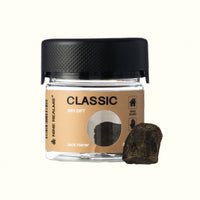
Knowing what a temple ball looks and feels like helps explain why it developed such a distinct reputation. When you first look at an authentic example, it has a dark, almost black exterior. This oxidized outer shell forms over time when the resin surface comes into contact with oxygen, which is a normal part of the cannabis resin curing process that also happens with other aged cannabis concentrates.
There is a big difference between the inside and the outside. When you cut or break open a quality temple ball, the core will be softer and lighter in colour. It may appear golden, brown, or amber. This resin maturation process, where the outside hardens while the inside stays soft, is one of the defining characteristics of traditionally made hash.
Most of the time, the smell is strong, earthy, and complex. Notes of spice, wood, and sometimes floral or fruity undertones reflect the terpene profile of the original plant material. It gets soft and easy to work with when you warm it between your fingers — a quality that means the Himalayan cannabis resin is high-grade and has not been watered down or changed in any way. Here are the key physical traits that make a well-made specimen stand out:
Hash Type |
Production Method |
Texture |
Geographic Origin |
Temple Ball |
Hand-rolled resin (charas technique) |
Soft interior, dark oxidized shell |
Nepal / Himalayan region |
Moroccan Pressed Hash |
Machine or hand-pressed dry-sift |
Firm, dense, uniform |
Morocco |
Ice-water separation, then pressed |
Varies; often crumbly to waxy |
Modern, global |
|
Machine-Pressed Block |
Mechanically compressed resin |
Hard, uniform block |
Various |
The way a cannabis temple ball is made is the biggest difference between it and other types of hash. When comparing charas vs pressed hash, the distinction becomes clear: Moroccan pressed hash is typically made from dry-sifted trichomes, where cannabis plant material is dried and then separated through fine screens to remove the resin glands. The resulting powder, known as kief, is pressed into blocks. This method is quick and scalable, but it differs fundamentally from the slow hand-collection method used in traditional Nepalese production.
Modern machine-pressed blocks focus on volume and consistency. They can be made quickly and uniformly, but they do not carry the character of something made by hand. Meanwhile, Bubble hash is a solventless cannabis concentrate made using ice water and filtering bags. Which makes it come closest to hash temple balls in terms of purity and trichome integrity, but it is a contemporary method with no historical overlap.
The fact that this kind of hash is made by hand, the quality of the source material, and the natural curing over time all make it one of a kind. These three things work together to make something that is hard to copy on a large scale.
The global reputation of the Nepal temple ball was largely shaped during 1960s cannabis culture, when significant cultural exchange happened between Europe, North America, and South Asia. The so-called Hippie Trail — an overland route stretching from Western Europe through Turkey, Iran, Afghanistan, India, and Nepal — brought thousands of travellers into direct contact with local cannabis traditions.
Nepal was an accessible destination on this route, and Kathmandu in particular became a popular place for travellers wanting to experience other cultures. Cannabis was legal in Nepal until 1973, and Himalayan cannabis resin was easy to find in good quality. Travellers brought nepal temple balls back with them to Europe and North America, where the product quickly became well-known. Key reasons for its enduring reputation:
These historical hash trade routes brought temple ball hash to an entirely new audience and made it a permanent part of cannabis culture history long before the internet or global e-commerce existed.
It is important to be clear about a change that has happened in recent decades. No matter where the cannabis was grown, people all over the world now use the term "temple ball" — or temple weed balls, as it is sometimes called informally, to describe any spherical, hand-pressed resin ball made using similar methods. Modern producers in Europe, North America, and elsewhere use high-quality raw materials and traditional hand-rolling methods to make products with the same name.
This is not misrepresentation. It shows how cannabis craftsmanship has evolved, with technique becoming more important than geographic origin. Even if the source plant grew in a greenhouse in the Netherlands rather than a Himalayan valley, a modern version made from high-quality resin, carefully shaped by hand, and allowed to cure still shares the essential characteristics of a hashish temple ball. When evaluating any modern product carrying this name, look for:
Temple ball hash occupies a unique position in cannabis history. It is one of the few cannabis products that can be traced directly to a specific cultural and geographic tradition, and its journey from the Himalayan hillsides to global recognition is a compelling story of craftsmanship, culture, and commerce.
At Nine Realms, we believe that people can make better, more confident choices when they understand what is a temple ball — where it truly comes from and what makes it special. This concentrate is more than just a product; it is part of a tradition that has been around for centuries and values patience, quality, and the natural properties of the plant.
Whether you encounter a traditional Nepalese temple ball or a modern interpretation made with equivalent care, what you are engaging with is one of the most artisanal forms of cannabis concentrate ever made. That history and craftsmanship deserves to be understood clearly and without exaggeration.
“Pressed by hand and matured by time, it carries history in every layer.”
A temple ball is a spherical form of hashish traditionally made by hand-rolling collected cannabis resin — a technique originating in Nepal and the broader Himalayan region. The result is a concentrate with a dark, oxidized outer shell and a softer, more flexible interior.
They are very similar but not the same. Charas is a term for freshly hand-collected resin that has not been shaped or aged. A temple ball is made by rolling and curing that collected resin into a sphere over time, which changes its texture, aroma, and appearance — making it a distinct form of traditional Nepalese hashish.
The term "temple ball" now refers as much to a technique as to a geographic origin. Modern producers using traditional hand-rolling methods and quality resin create products that share the defining characteristics of historically authentic temple balls hash. Authenticity is better judged by method and material quality than by place of origin alone.
Author: Edijs Eleksis
Growing up in a country where cannabis was stigmatized and even shamed, Edijs faced many roadblocks to get to enjoy the benefits of this plant. However, as more countries worldwide are opening up to the idea of cannabis-available society, Edijs is inspired to take on a mission: spreading awareness about cannabis and its industry in Europe through engaging, educational blog content. Because only with more information, humans as a collective, can make decisions that are better for all of us!


