
What is THCP? Effects, 2026 Legal Status, and Product Guide
|
|
Time: 13 min


Product Finder
Find Your Nine Realms Match
Answer 5 quick questions to find your perfect cannabinoid product.
How familiar are you with cannabinoid products?
What kind of product are you looking for?
Where and how do you usually use cannabis?
What kind of effect are you looking for?
When should it kick in, and how long should it last?

Welcome to
Nine Realms
Our store is intended exclusively for people 18 years of age or older. Please confirm your age to continue.
By clicking here, you agree to our Terms and Conditions and Privacy Policy.
|
|
Time: 13 min
THCP showed up in German cannabinoid forums almost overnight, and most of what got said about it was wrong. Short for tetrahydrocannabiphorol, the compound was only identified in 2019. The number everyone quotes, a CB1 receptor binding affinity roughly 33 times higher than THC, gets repeated constantly and explained almost never. This guide walks through what the compound actually is and what's changed since, legally, across Germany and the wider EU. You'll want to know upfront: past tense matters here. More than most articles let on.
Table of Content
TL;DR: A rare cannabinoid, discovered in 2019, that binds to CB1 receptors far more readily than THC does in lab tests. Higher binding affinity doesn't automatically mean a stronger high, though a documented 2025 case shows exactly why that gap still matters. Illegal to manufacture, sell, or trade in Germany since 27 June 2024, under the NpSG. France banned it a few weeks earlier still, on 3 June 2024. Spot "THCP" for sale in a German shop today? You're probably looking at old stock, or a mislabeled listing that never got pulled.
December 2019. A team of Italian researchers led by Cinzia Citti, at the University of Modena and Reggio Emilia, isolated tetrahydrocannabiphorol, THCP for short, from an Italian cannabis sativa cultivar called FM2. The study, published in *Scientific Reports, identified a compound with a seven-carbon alkyl side chain, two carbons longer than THC's five-carbon chain. That extra length is the whole story here. Researchers measured its CB1 receptor binding at roughly 33 times greater affinity than Δ9-THC in lab assays (Ki approximately 1.2 nanomolar versus roughly 40 nanomolar for THC).
Unlike HHC, made synthetically by hydrogenating THC, this cannabinoid occurs naturally in the cannabis plant. Trace amounts, though. Well under a hundredth of a percent by weight, typically. That's why almost every product on the market has historically been made by chemically converting hemp-derived CBD, since pulling it directly from a plant that barely produces any just isn't practical at scale. If you've bought something labelled THCP, chances are that's exactly what you got: hemp CBD, rearranged in a lab.
THCP |
|
Discovered |
December 2019, Citti et al., Scientific Reports |
Source cultivar |
FM2 (Italian cannabis sativa strain) |
Molecular difference from THC |
7-carbon side chain vs. THC's 5-carbon chain |
CB1 binding affinity |
~33x THC in lab assays (Ki ~1.2nM vs ~40nM) |
Occurs naturally? |
Yes, in trace amounts; most products are hemp-derived and lab-converted |
Legal to sell in Germany (2026) |
No, banned under the NpSG since 27.06.2024 |
Most of what circulates about this topic gets one thing wrong: a 33-times-higher binding affinity in a lab assay isn't the same as a 33-times-stronger high. Binding affinity measures how readily a compound latches onto a receptor in your endocannabinoid system. Nothing more. It says nothing about how strong the downstream psychoactive effect ends up being once:
That's just how binding-affinity numbers work. The original 2019 study did find a stronger cannabimimetic response than THC in animal testing. Genuinely significant, but a narrower, more specific claim than the "30x stronger" shorthand that circulates online. Treating it as a straightforward multiplier overstates what the data actually supports.
Does a lab number that high tell you anything about how strong your actual high will be? Only indirectly. That's exactly the point here. What you'd feel, based mostly on user accounts rather than controlled human trials, sits in territory similar to a strong THC experience: euphoria, relaxation, a shift in how sound and light register. Push the dose higher and the chance of anxiety or paranoia climbs too, especially if you're already prone to it. Most of what circulates about the specific effects, beyond the receptor-binding data, comes from online user reports and forum chatter. Real people describing real experiences, unverified by anyone with a lab coat. Treat it as anecdote.
Human data isn't entirely absent, though. One documented case matters more than the rest. A 2025 case report in PCN Reports: Psychiatry and Clinical Neurosciences described a 41-year-old man, an experienced THC user with no history of psychosis, who developed acute psychotic symptoms within an hour of taking a single 8mg gummy and required emergency psychiatric hospitalisation after a serious self-harm incident. He recovered after inpatient treatment. One case report doesn't establish how common a reaction like that is. But it's real, peer-reviewed evidence: the stronger receptor binding can translate into a stronger, and in this case dangerous, real-world effect than the lab figure alone suggests. That's the gap between a binding-affinity number and a familiar, lower-potency THC product.
That same gap between lab data and real life shows up in the wellness claims that circulate about THCP too. Worth naming plainly, since nobody else seems to bother:
None of this is medical advice, and none of it claims THCP treats anything. Just a summary of what gets said about it online and in early research discussion, labelled honestly as exactly that.
The full breakdown lives in our dedicated THCP vs THC comparison. Short version below, if you just need the numbers.
THC (Delta-9) |
THCP |
|
Side chain length |
5 carbons |
7 carbons |
CB1 binding affinity (lab) |
Baseline |
~33x higher |
Legal status in Germany (2026) |
Restricted (BtMG / KCanG framework) |
Banned (NpSG, since 27.06.2024) |
Natural abundance in cannabis |
Moderate to high |
Extremely low (trace) |
Most products derived from |
Direct plant extraction |
Hemp-derived CBD, chemically converted |
HHC is lacking the formidable strength of THCP, however still retains substantial potency. Since THCP is considered stronger than THC, it is also stronger than HHC, making it a more potent alternative in the cannabinoid market.
The hydrogenated variant of THCP shares similarities with its original. This relationship is similar to how HHC represents the hydrogenated version of THC. Exhibiting psychoactive properties, HHCP stands out by providing more long-lasting effects.
Unlike THCP, H4CBD is mildly psychoactive cannabinoid derived from CBD not THC, making it an appealing option for individuals seeking more relaxed experience.
It is a naturally occurring cannabinoid in the THC plant. When combined with other cannabinoids, THCP amplifies their effects.
Valuable option for those seeking potent relief without consuming large amounts of cannabis or for seasoned consumers with high tolerance.
It isn't legal to manufacture or sell in Germany anymore, but the range of formats it came in is still worth knowing. Maybe you're evaluating stock already sitting in your cupboard (we won't ask why it's still there). Maybe you spot something similar while travelling and want to know what you're looking at. Either way, the formats matter more than the ban does at this point.
Format |
Typical onset |
Typical duration |
Usually suited to |
What to watch for |
Vape / diffuser |
Minutes |
2 to 4 hours |
Experienced users wanting fast, adjustable dosing |
Easiest to overdo by taking another puff before the first one has registered |
Flower (Blüten) |
Minutes (smoked) |
2 to 4 hours |
Users who prefer a traditional smoking or vaporising ritual |
Potency varies significantly between batches; lab reports matter more here than with isolated distillates |
Oil / distillate |
30 minutes to 2 hours (sublingual/oral) |
4 to 8 hours |
Users wanting a smoke-free, longer-acting option |
Dosing precision depends entirely on the product's labelled concentration being accurate |
Gummies / edibles |
30 minutes to 2 hours |
4 to 12 hours |
Beginners who want a slow, predictable, pre-dosed format |
Delayed onset means it's tempting to redose too early; effects can be stronger and longer than expected |
Liquid (drops) |
15 to 45 minutes |
3 to 6 hours |
Users wanting flexible, adjustable micro-dosing |
Same accuracy caveat as oils; concentration claims aren't always independently verified |
Hash |
Minutes (smoked/vaporised) |
2 to 4 hours |
Experienced users familiar with traditional resin products |
Often blended or infused rather than pure, so labelled potency can be misleading |
Vapes and flowers were historically the two most commonly sold formats in the German and wider European market. Simple reason: they mirrored how THC products were already being sold, so the buying habit already existed. Gummies and oils drew more cautious, dose-conscious buyers. Hash stayed smaller, more of a niche category for people already familiar with traditional cannabis resin.
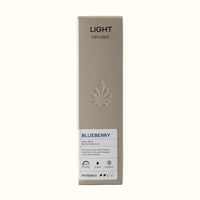
Vape and diffuser formats were how most people in Germany bought it before the ban. Straightforward reason: they mirrored the vaping equipment people already owned for THC and HHC products, so switching cannabinoids just meant buying a new cartridge. The tradeoff was speed. Inhaled effects arrive within minutes, and that speed makes it easy to take another puff before the first dose has even registered. Any inhaled cannabinoid carries that risk. This one carries it a little harder, given the binding-affinity numbers above.
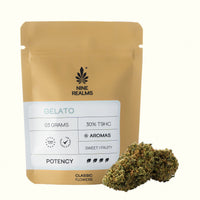
Flower (Blüten) occupied a different niche. Natural occurrence in raw cannabis flower is vanishingly small, so essentially all THCP-labelled flower on the market was hemp flower infused or sprayed with the distillate after harvest. Very little of it grew the compound naturally on its own. That distinction mattered for quality. Infusion evenness varied a lot between producers (glamorous work, spraying distillate onto hemp flower, truly). Independent lab verification mattered more here than it did for liquid or gummy formats, where the cannabinoid was easier to mix in evenly.
A few things were always worth checking before you bought, whatever the format, and the same checklist is still good practice for any cannabinoid product you pick up today: an independent third-party lab report confirming actual cannabinoid content, a clearly labelled concentration (not just a vague "high potency" claim), honesty from the seller about whether it was naturally extracted or chemically converted from CBD, and ideally a batch number you could trace back to that lab report. The latter, chemical conversion, is by far the more common production method.
No. Not in Germany. This cannabinoid, along with HHC, H4CBD, HHCP, THCPO, and several other semi-synthetic compounds, was added to the Neue-psychoaktive-Stoffe-Gesetz (NpSG) through the same Fifth Ordinance that banned HHC. The ban took effect on 27 June 2024. Manufacturing, trading, marketing, importing, or exporting these products in Germany is illegal. As with HHC, personal possession of existing stock wasn't separately criminalised under the NpSG, but there's no legal channel for you to buy new stock in Germany today.
If you're seeing "THCP" products for sale from a German retailer right now, something doesn't add up. Maybe the listing is outdated and never got pulled. Maybe the product's been reformulated to a compliant compound without the copy catching up (a pattern we found on our own site while researching this piece, more on that below). Or the seller simply isn't compliant. None of it means the compound itself is legal to buy here.
Separate from the sale-and-supply question: standard drug tests screening for THC metabolites can flag this compound's use too. And driving under the influence of any psychoactive cannabinoid carries the same legal risk in Germany as driving under THC does. Those practical risks don't disappear just because the product itself has been banned from sale.
Germany isn't the only country to have acted. France moved first, if only by a few weeks. THCP was added to France's controlled-substances schedule via an ANSM decision effective 3 June 2024, just over three weeks before Germany's own ban, covering manufacture, sale, and use. Beyond Germany and France, the THCP legal status across the rest of the EU stays genuinely inconsistent, and it changes fast enough that a blanket statement would be irresponsible. Several other EU member states have moved against semi-synthetic cannabinoids as a category over the past two years, but the details vary by country and by exactly which compounds get named. Does a ban like this actually stop people from finding it? Rarely right away. But it does mean anyone still selling it openly is breaking the law. If you're anywhere outside Germany or France, check your own country's current regulations directly. Older articles go stale fast, including, until this update, ours.
We used to have THCP products, including a vape version aimed at newcomers. While researching this article update, we found the product this article used to recommend had already been absent from the store for more than a year, and reformulated. Its listing still said "THCP distillate." The actual product now runs on T9HC, a compound that stays compliant under current German law.
The article content just hadn't caught up. We've fixed that here instead of leaving an inaccurate product description live. We're not using this section to point you toward a replacement purchase, either. What Nine Realms currently sells is a separate conversation. This article exists to explain THCP itself, honestly, so you get the whole picture regardless of what we currently sell.
Open conversation beats exaggeration every time. That applies as much to what we say about a compound we no longer sell as it does to anything currently on our shelves. It would have been easy to leave this article exactly as it was written in 2025: still pointing at a discontinued product, still stating unqualified health claims, still silent on the fact that German law had changed underneath it, still written as if nothing had moved at all (easy to miss until someone actually goes and checks).
But instead, we corrected the product mismatch we found, added the legal update this page was missing, and got specific about which of the reported benefits come from real research and which come from online anecdote.
THCP earned its reputation from one striking data point: a CB1 binding affinity roughly 33 times higher than THC, measured in a 2019 laboratory study. That figure is real. It also describes receptor binding in a lab assay. That's a different thing entirely from real-world potency, and the gap between the two is exactly where most of the online hype about this cannabinoid got started.
If you're reading this in Germany, or weighing whether to buy it anywhere else in the EU, the update that matters most is legal. Manufacturing and selling THCP has been illegal in Germany since 27 June 2024, and France acted a few weeks earlier still. An article or a product listing telling you otherwise is simply out of date.
The most interesting thing about THCP was never how strong it was. It was how fast the ground shifted underneath it.
No. Illegal to manufacture, trade, or sell in Germany since 27 June 2024, when it went into the NpSG in the same amendment that banned HHC.
27 June 2024, under the Fifth Ordinance amending the NpSG's substance list, alongside HHC, H4CBD, and several other semi-synthetic cannabinoids, all in one action.
France banned it a few weeks earlier, via an ANSM decision effective 3 June 2024. Elsewhere in the EU, status varies and changes fast. One article can't track every jurisdiction. Check your own country's current regulations directly.
Lab research measured its CB1 binding affinity at roughly 33 times that of THC. That's a receptor-binding number, not a real-world potency multiplier. A documented 2025 case report shows the real-world effect can still be severe. What you actually feel depends on dose, product, tolerance, and your own body chemistry.
Infused flower was a commonly sold format before the German ban. Hemp flower, usually, coated with distillate after the fact. Natural occurrence in raw flower is extremely low, so almost none of it grew the compound on its own.
A liquid format, usually taken sublingually or orally. Smoke-free, with a slower onset (30 minutes to 2 hours) and a longer duration than smoking or vaping formats.
A research team led by Cinzia Citti, at the University of Modena and Reggio Emilia, published the discovery in Scientific Reports in December 2019. They'd been working with an Italian cannabis sativa cultivar called FM2.
A longer molecular side chain, seven carbons versus THC's five, and much stronger CB1 receptor binding in lab testing. Beyond that structural and binding-affinity difference, human research is still limited. See our full THCP vs THC comparison for the rest.
Author: Jans Beloglazovs
Emerging from Europe's strict cannabis landscape, Jan has become a known figure in the European cannabis industry through vast experience in cannabusiness and a keen understanding of the shifting trends in Europe. Co-founding the Nine Realms cannabis brand, he leverages his expertise to advocate for progressive cannabis policies and educate a broad audience.


