


AK 47 Strain: Cannabis Genetics, Effects and Everything In Between
|
|
Time: 14 min


Product Finder
Find Your Nine Realms Match
Answer 5 quick questions to find your perfect cannabinoid product.
How familiar are you with cannabinoid products?
What kind of product are you looking for?
Where and how do you usually use cannabis?
What kind of effect are you looking for?
When should it kick in, and how long should it last?

Welcome to
Nine Realms
Our store is intended exclusively for people 18 years of age or older. Please confirm your age to continue.
By clicking here, you agree to our Terms and Conditions and Privacy Policy.
|
|
Time: 14 min
The AK-47 strain carries one of the trickier genetics stories in cannabis, a four-way cross built from landrace lines on three continents. Most famous hybrids trace back to two parents. AK-47 stacks four. Somehow the plant still holds together as a consistent, well-documented release from Serious Seeds. Here's the deep version of that story, told parent by parent: the identification question people actually search for, terpenes, effects, potency, awards, and where the strain sits in the Nine Realms range today.
Table of Content
TL;DR: AK-47 is a sativa-leaning hybrid built from a four-way cross of Colombian, Mexican, Thai, and Afghani landrace genetics, released by Serious Seeds in the mid-1990s. THC gets reported across a wide range depending on phenotype and grower, and CBD sits low. The effect is a long, steady, cerebral-forward high that stays functional rather than sedating. Unusual, given how much indica ancestry sits in the cross. Multiple Cannabis Cup placements through the 1990s and 2000s cemented its reputation as a benchmark hybrid. Nine Realms carries the strain in the PRO pre-roll line at 80% T9HC, aimed at experienced users who want strength without guesswork.
Attribute |
AK-47 |
Type |
Sativa-leaning hybrid (four-way landrace cross) |
THC |
Wide reported range, varies by phenotype and grower |
CBD |
Low, typically under 1% |
Lineage |
Colombian × Mexican × Thai × Afghani (Serious Seeds, mid-1990s) |
Dominant terpene |
Reported inconsistently across sources, treat as unconfirmed |
Aroma |
Earthy, sour, with floral undertones (commonly described) |
Effects |
Long-lasting cerebral high, functional rather than sedating |
Those figures are ranges, not specs. Every harvest moves them, and the published sources on AK-47 disagree with each other more than they do for most famous strains.
Serious Seeds released it, a Dutch breeder founded in the early 1990s, and what came out was a sativa-leaning hybrid that reached the market in the middle of that decade and never really left. It's stayed in circulation for three decades now. That says something, given how much the cannabis catalogue has turned over in that time.
The name draws the obvious question first. It has nothing to do with violence. The rifle reference points at speed and force of effect, a fast-hitting, hard-landing high that early growers thought deserved a name people would remember. Whatever you think of the branding choice, it worked. Few strain names carry this much instant recognition, and fewer still have kept it for three decades without a rebrand.
Most hybrids you'll meet are two-way crosses. Take one parent, take another, cross them, stabilise the line, done. The AK-47 strain skips that pattern entirely. Serious Seeds built it from four distinct landrace gene pools, Colombian, Mexican, Thai, and Afghani, an unusually ambitious combination and most of what makes this genetics story worth telling at length.
Serious Seeds was founded by a breeder known publicly as Simon, working out of the Netherlands in the early 1990s cannabis scene that also produced Sensi Seeds and several other breeders still active today. Nobody's ever laid out the exact breeding sequence in public, which landraces went in first and in what proportion. Breeders rarely publish precise ratios for a stabilised line.
The intent, though, is well documented. Stacking four landraces from three regions, South America, Southeast Asia, and Central Asia, amounts to a genetics gamble. Landraces are wild-type, region-specific populations adapted to their local climate over centuries, and crossing that many together risks an unstable plant expressing unpredictably from seed to seed. Serious Seeds stabilised it anyway. The fact that AK-47 cannabis still grows true to type decades later is the real achievement here, more than the novelty of the cross itself.
Each landrace in the cross contributes something specific. The plant's overall character reads as the sum of these four inputs rather than any single one dominating.
Colombian landrace genetics supply the sativa backbone. Colombian sativas are traditionally tall, long-flowering plants associated with a clear-headed, energetic high, and that character shows up directly in AK-47's long cerebral arc. This parent does most of the work behind the strain's reputation for a high that lasts rather than spikes and fades.
Mexican landrace genetics reinforce the sativa-leaning structure and add to the earthy note running through AK-47 cannabis strain’s aroma. Mexican sativas share a lot structurally with their Colombian cousins, tall and fibrous. Put the two together and you get most of the explanation for why AK47 leans sativa-dominant despite having two indica-adjacent and two sativa-adjacent parents in the mix.
Then there's Thai, which brings the uplift. Thai sativas rank among the most cerebral, energetic landraces in cultivation, historically prized for a bright, sociable high, and this is likely where AK-47's staying power without heaviness partly comes from. Thai genetics are also notoriously slow to flower in pure form, part of why breeders cross them rather than grow them straight.
Afghani genetics are the counterweight. Where the other three parents push toward sativa territory, Afghani landrace brings the indica structure: shorter plant, denser bud formation, and body relaxation that keeps AK-47's effect from tipping into cerebral overdrive. Without it, this would likely be a much twitchier high. With it, the plant lands more balanced than its three-quarters-sativa parentage would suggest on paper. The same Afghani × Thai pairing shows up as the entire foundation of Northern Lights, which says something about how far a shared parent can travel across two very different strains.
Fair question. AK-47 is a well-known name, and well-known names get misused. A grower selling generic sativa-hybrid flower under a recognisable label isn't a new problem in cannabis.
A few markers tend to travel with authentic AK-47 cannabis flower. Growers usually describe the bud structure as dense but not rock-hard, with a good coating of trichomes, consistent with its mixed sativa-indica heritage. The aroma leans toward the earthy-sour-floral combination covered below, though it shifts with curing and storage, so a sniff test alone proves less than people assume. Probably the most useful marker is the effect itself: a long, steady cerebral lift that stays functional, without the heavy indica crash you'd expect from this much landrace stacking.
None of that adds up to proof. Appearance, aroma, even effect, all of it can be approximated by other sativa-leaning hybrids, deliberately or by accident. The only real way to confirm genetics is a verified seed source, whether that means buying from Serious Seeds directly, a licensed reseller, or a supplier who can trace the cultivar back to a documented lineage. Visual and aroma cues are useful context. Not confirmation.
Crack a jar of AK-47 flower and the sour edge tends to hit first, sharper than a typical earthy indica, before the soil-and-wood tone settles in behind it. People generally describe the aroma as earthy at the base, with that distinct sourness on top and a floral note that shows up more on the exhale than the inhale.
The flavour mostly tracks the aroma: sour and earthy on the inhale, with the floral character more noticeable as the smoke lingers. It's distinctive enough that experienced users often pick AK-47 buds out of a lineup by nose alone, though as covered above, smell is a strong hint rather than a genetics test.
Nobody's pinned down the dominant terpene in the AK-47 strain with any real consistency, and that's true more here than for most well-documented strains, so the claim gets flagged rather than stated with false precision. Caryophyllene, myrcene, and limonene all show up across different lab analyses and grower reports, and any of the three could reasonably get called the lead depending on the specific phenotype tested.
Broadly, what that terpene mix contributes tracks with the plant's overall character. Caryophyllene brings a peppery, grounding note associated with calm that doesn't tip into sedation. Myrcene, where present in meaningful concentration, leans toward the earthy, slightly couchy end of the spectrum, though clearly not dominant enough to overwhelm AK-47's cerebral-forward reputation. Limonene adds brightness that would help explain the sativa-leaning energy on top of the landrace genetics doing the heavier lifting. Genuinely an open question in the available literature, and probably staying that way.
The AK-47 strain doesn't creep in slowly the way a heavy indica does. Onset is reported as fairly fast, and the cerebral lift arrives early rather than building over half an hour.
What follows is a long, steady plateau rather than a sharp peak-and-fade. The mind stays active and clear. People describe it consistently as functional rather than overwhelming, closer to a sustained, useful focus than a racing high. Underneath, the Afghani component contributes mild body relaxation, present enough to notice, not heavy enough to compete with the head-forward effect leading the experience. Duration is one of the more consistently repeated claims about this strain, long-lasting compared to many hybrids, which lines up with the Colombian and Thai sativa genetics behind the cerebral arc.
The AK-47 strain's THC content gets reported across an unusually wide range in the available sources, wider than the spread you'd see for a strain like Jack Herer or Northern Lights. Phenotype, growing conditions, and which breeder or grower produced the batch all move the number meaningfully. Serious Seeds, the strain's original breeder, cites a lab-tested 21.5% THC result from the 1999 Cannabis Cup. That's one of the few hard numbers attached to AK-47 that traces directly back to the source rather than secondhand repetition, so it's worth stating plainly. One documented data point, though, not a guarantee for every phenotype or grower.
CBD sits low across essentially all reported testing, typically under 1%. Standard for a strain bred for psychoactive effect rather than a balanced cannabinoid profile.
Most sources lean sativa when describing the AK-47 strain, though the exact ratio depends on who you ask, even among named experts. Cannabis writer Ed Rosenthal has attributed a 65/35 sativa-to-indica ratio to AK-47, while physician Rav Ivker has instead cited a 50/50 balance for the same strain. Both are credible, named sources describing the same plant differently. Worth remembering next time someone states a single precise ratio like it's settled. Three of its four landrace parents (Colombian, Mexican, and Thai) sit on the sativa side, with Afghani supplying the indica counterweight.
That parentage explains the plant's character better than a simple ratio does. A pure three-quarters-sativa cross would likely run hot and slightly anxious. The Afghani quarter tempers that, adding enough body presence that AK-47 reads as more grounded than its sativa-heavy family tree would suggest, without ever tipping into indica-dominant territory. Sativa-leaning, with a noticeably heavier body underneath than most sativas carry.
The AK-47 strain built a real competitive record through the 1990s and 2000s, and Cannabis Cup placements from that period come up again and again in strain writeups. Serious Seeds itself puts a number on that record: a career tally of 27 awards, broken down as 8 gold, 10 silver, and 9 bronze. That breeder-published figure is the most solid anchor available here, and it carries more weight than the specific placements below.
Beyond the breeder's own tally, cannabis strain databases point to more specific placements. A podium finish (commonly cited as third place) in the Hybrid category at the 2011 High Times Cannabis Cup. A Treating Yourself Cup placement in Toronto around 2010-2011, sources disagree on the exact year. These circulate frequently across secondary strain-database sourcing rather than being confirmed directly by Serious Seeds, so the specific years and categories are best treated as widely repeated rather than settled fact.
The strain's cultural legacy runs deeper than trophy count. AK-47 became a reference point for what a stable, multi-landrace hybrid could achieve. Its genetics show up as an influence in later crosses chasing the same long, functional cerebral profile, including named descendants such as White Russian, The Chronic, and AK48.
This section is for growers, not smokers, so take the figures as grower-reported ranges, not a fixed specification. The AK-47 strain grows both indoors and outdoors, and its landrace-heavy background shows up in how the plant behaves in the tent.
Flowering time runs on the shorter side for the AK-47 strain, typically around seven to eight weeks. Faster than you'd expect given how much sativa landrace genetics sit in the cross. Growers generally credit the Afghani parent for that relative speed, since indica genetics tend to flower faster than sativa. Plant structure leans toward moderate height with a bushier profile than a pure sativa would show, again likely the Afghani influence. Yield gets described as solid, not exceptional. Reasonable for a hobbyist setup, though it won't match yield-bred commercial hybrids.
Difficulty sits in the moderate band. Growers tend to call it forgiving relative to many sativa-heavy crosses, partly because the Afghani genetics bring hardiness that pure landrace sativas typically lack. Not really a beginner plant, but experienced home growers tend to describe it as manageable.
Most strain pages skip this part. In Germany, cannabis genetics with strong reputational recognition, the AK-47 strain among them, show up referenced in the licensed medical cannabis system. The mechanism itself is straightforward: under the Cannabis auf Rezept framework, a doctor prescribes a specific cultivar and THC range. The patient then collects that prescribed product from an Apotheke, the same dispensing model used for any other prescription medicine. We're deliberately not naming specific pharmacy brands or suppliers here, since availability shifts with the supply chain. Pharmacy-tested cultivars typically get labelled to pharmaceutical standards, which usually means more conservative cannabinoid figures than the wide range reported for the recreational seed-bank phenotype.
If you're reading about AK-47 for medical use, the pharmacy pathway is the relevant reference, not the recreational genetics covered through the rest of this guide.
Flower and joints are the classic route for the AK-47 strain, and that's been true since the 1990s. For a similar classic-hybrid, cerebral-forward flower, our own White Widow hits a comparable energetic note. AK-47's dense, trichome-covered bud structure suits rolling and smoking well, and its long cerebral arc is part of why it's stayed popular in that format specifically.
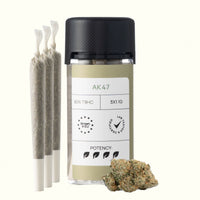
Nine Realms carries AK-47 weed in the PRO pre-roll line, built at 80% T9HC. This is a deliberately strong format, positioned for a specific audience: experienced cannabis enthusiasts who already know what they want and aren't looking for a gentle introduction.
The genetics behind it are the same four-way landrace cross covered throughout this guide, carried through into a concentration built for people who want strength without guessing at it batch to batch. If that describes where you are with cannabis, the PRO pre-rolls are worth a direct look.
A good strain page explains what a plant feels like. A better one explains why the plant is still around after three decades of a catalogue that replaces itself constantly. The AK-47 strain has lasted because the genetics story is real, four landraces stabilised into one consistent plant, and because the effect it produces has stayed identifiable across thirty years of growers running their own versions of it.
That's also why the PRO pre-roll line makes sense as AK-47's home in the Nine Realms range. The strain was never built as a gentle option. It was built for a long, functional, cerebral-forward experience, and 80% T9HC carries that intent through into a format that doesn't soften it.
AK-47 combines complicated four-way genetics, a real competitive history through the 1990s and 2000s, and an effect that's stayed consistent across three decades of cultivation. Few strains carry that combination this long, and fewer still are sold under their original name three decades on.
Whether you came for the genetics story or the PRO pre-roll line specifically, the same fact holds. AK-47 is one of the small number of 1990s hybrids that never needed a rebrand to stay relevant.
"Four landraces, one plant — thirty years of proof it works."
AK-47 is a sativa-leaning cannabis hybrid built from a four-way cross of Colombian, Mexican, Thai, and Afghani landrace genetics, released by Serious Seeds in the mid-1990s. It's one of the few hybrids stacked from four distinct landrace gene pools rather than the usual two-parent cross.
Sativa-leaning, with three of its four landrace parents (Colombian, Mexican, and Thai) sitting on the sativa side and Afghani supplying the indica counterweight. The effect reads as a long, steady cerebral high with more body presence underneath than most sativas carry.
Dense but not hard-packed bud structure, an earthy-sour-floral aroma, and a long, functional cerebral effect without a heavy crash are the markers people point to. None of these confirm genetics on their own. The only reliable way to verify AK-47's lineage is a verified seed source that can trace the cultivar back to a documented breeding line.
Author: Jans Beloglazovs
Emerging from Europe's strict cannabis landscape, Jan has become a known figure in the European cannabis industry through vast experience in cannabusiness and a keen understanding of the shifting trends in Europe. Co-founding the Nine Realms cannabis brand, he leverages his expertise to advocate for progressive cannabis policies and educate a broad audience.


